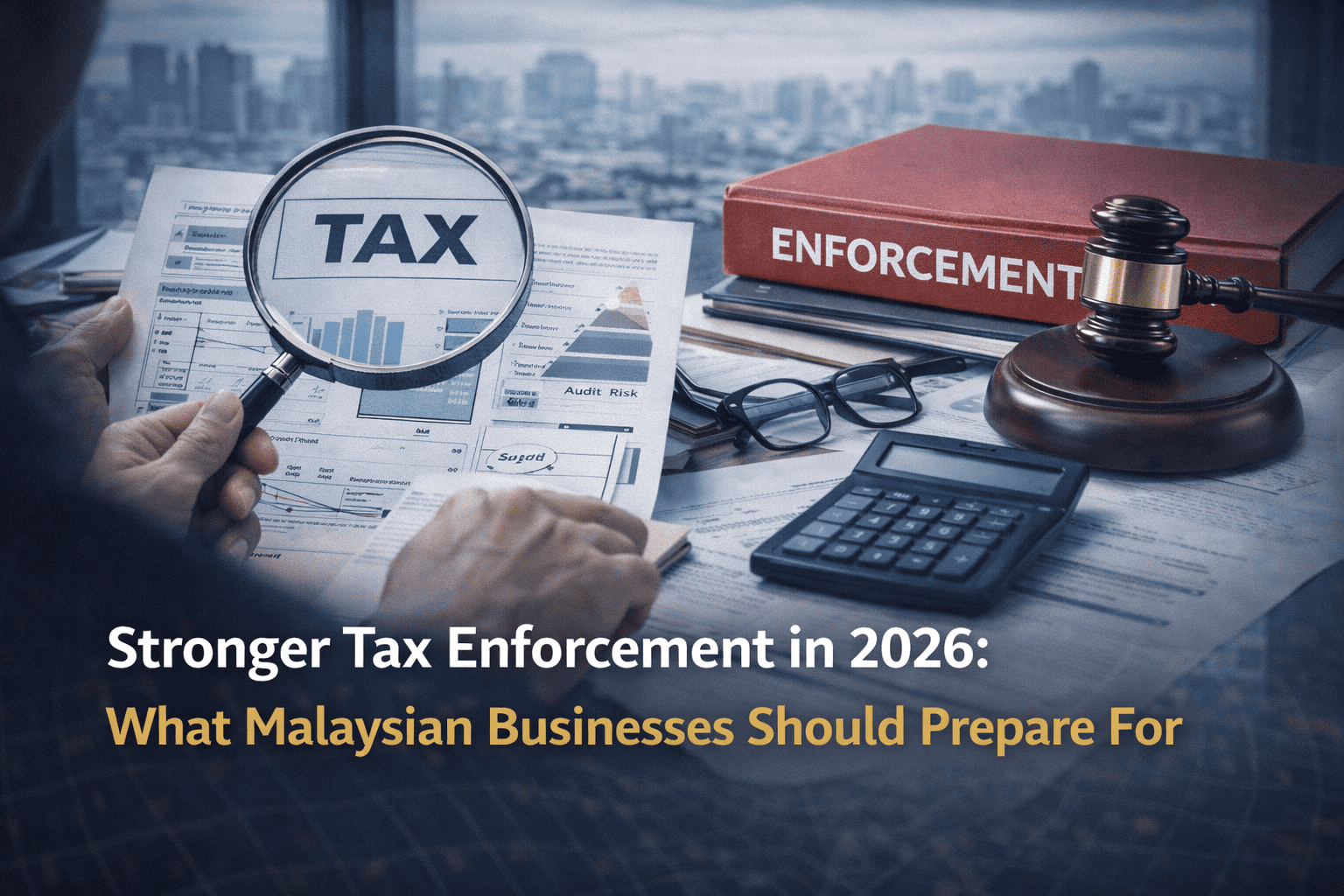
In 2026, Malaysia’s tax environment is not defined by new tax rates.
It is defined by stronger enforcement.
With digital systems, improved data visibility, and tighter monitoring, tax authorities are focusing more on accuracy, consistency, and compliance behaviour.
For businesses, this represents a shift.
The risk is no longer just about filing late.
It is about whether your records can withstand scrutiny.
Enforcement Is Becoming More Data-Driven
Tax authorities today are no longer relying solely on manual audits.
They are supported by:
- Digital reporting systems
- Data cross-checking
- Transaction-level visibility
- Automated analysis
This means discrepancies can be identified faster and more consistently.
What was previously overlooked may now be flagged.
Compliance Is No Longer a Year-End Activity
Many businesses still approach tax compliance as a yearly obligation.
Prepare accounts.
Submit returns.
Move on.
In 2026, this approach is increasingly risky.
Compliance now depends on:
- Daily transaction accuracy
- System consistency
- Proper documentation
- Internal controls
Errors made during the year do not disappear at filing stage.
They accumulate.
Where Businesses Commonly Face Exposure
Most compliance issues do not come from deliberate underreporting.
They arise from operational gaps such as:
- Inconsistent revenue recording
- Misclassification of transactions
- Weak documentation support
- Disconnected accounting systems
- Lack of internal review processes
These gaps create patterns.
And patterns are what modern systems detect.
SST, e-Invoice, and Reporting Alignment
With the continued implementation of:
- e-Invoicing
- SST monitoring
- Digital reporting systems
Authorities can compare:
- Reported revenue
- Transaction records
- Tax declarations
Misalignment between these areas increases audit risk.
Businesses must ensure all systems speak the same language.
The Cost of Getting It Wrong
Stronger enforcement does not just mean higher chances of detection.
It means higher impact when issues arise:
- Financial penalties
- Backdated tax liabilities
- Operational disruption
- Reputational concerns
- Delays in financing or transactions
The real cost is not the penalty.
It is the disruption to business continuity.
From Reactive to Preventive Compliance
The shift in 2026 is clear:
From reacting to audits → to preventing exposure.
Businesses that adapt focus on:
- Structured record-keeping
- Consistent reporting processes
- System integration
- Periodic internal reviews
Preventive compliance reduces risk before it becomes visible.
Questions Every Business Should Ask
- Are our financial records consistent across all systems?
- Can we justify our reported figures if reviewed?
- Are our processes dependent on manual adjustments?
- Do we review our compliance position regularly?
- Are we prepared for data-based scrutiny?
If the answers are unclear, the risk is not theoretical.
How AMRE Supports Businesses in This Environment
At AMRE Management Services, we focus on building structured compliance systems, not just fulfilling filing requirements.
Our approach includes:
- Compliance risk assessment
- Financial reporting alignment
- SST and tax review
- Documentation structuring
- Process improvement
We help businesses move from uncertainty to clarity.
Final Thought
2026 is not about higher taxes.
It is about higher expectations.
Businesses that rely on outdated processes will face increasing pressure.
Those that strengthen their systems will operate with confidence.
If your company has grown, expanded, or evolved, now is the right time to review whether your compliance structure is ready for a more transparent environment.