Most Businesses Are Preparing the Wrong Way
When SMEs hear “e-invoicing,” the first reaction is:
“Which system should we use?”
But that’s the wrong question.
Because e-invoicing is not just about software.
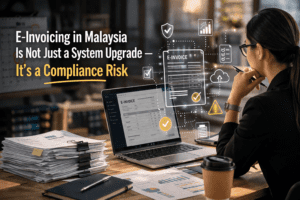
It’s about visibility, control, and compliance.
And once it’s implemented,
there is no more room for inconsistency.
What’s Really Changing
With Malaysia’s e-invoicing rollout led by LHDN, transactions will no longer sit quietly inside your system.
They will be:
- Captured in real time
- Standardised
- Traceable
This means your business activity is no longer just internal.
It becomes visible — and reviewable.
Why This Matters for SMEs
Many SMEs today operate with:
- Manual adjustments
- Delayed entries
- Inconsistent documentation
- Disconnected systems
These issues were manageable before.
With e-invoicing, they are not.
Because once data is submitted:
- Errors are recorded immediately
- Discrepancies become traceable
- Corrections become more difficult
The Real Risk Isn’t the System
The biggest misconception is this:
“Once we install the system, we are compliant.”
In reality:
A system only processes what you give it.
If your internal processes are:
- Inconsistent
- Inaccurate
- Poorly structured
Then e-invoicing will not fix them.
It will expose them.
Common Risk Areas SMEs Overlook
1. Data Accuracy from Source
Incorrect:
- Customer details
- Tax codes
- Transaction classification
These are no longer minor issues —
they become compliance risks.
2. Process Gaps Between Teams
Sales, operations, and accounting often operate separately.
Result:
- Mismatched data
- Missing records
- Delayed reporting
E-invoicing requires alignment.
3. Lack of Internal Control
Without structured review:
- Errors pass through
- Inconsistencies accumulate
- Risk builds over time
What SMEs Should Be Doing Now
This is not about rushing into a system.
It’s about preparing your business properly.
Fix Your Process Before Your System
Ensure:
- Transactions are recorded correctly at source
- Documentation is consistent
- Workflows are clear and repeatable
Align Your Operations and Accounting
E-invoicing requires:
- Real-time accuracy
- Cross-team coordination
Not just accounting compliance.
Strengthen Internal Review and Control
Build checkpoints for:
- Data validation
- Transaction accuracy
- Compliance consistency
A Shift in How Businesses Operate
E-invoicing changes one fundamental thing:
👉 You can no longer rely on fixing things later.
Everything must be:
- Accurate from the start
- Structured properly
- Controlled internally
Final Insight
E-invoicing is not an IT project.
It is a shift in how your business:
- Records transactions
- Maintains accuracy
- Manages compliance
The businesses that treat it as a system upgrade
will struggle.
The ones that treat it as a control and governance shift
will be ready.