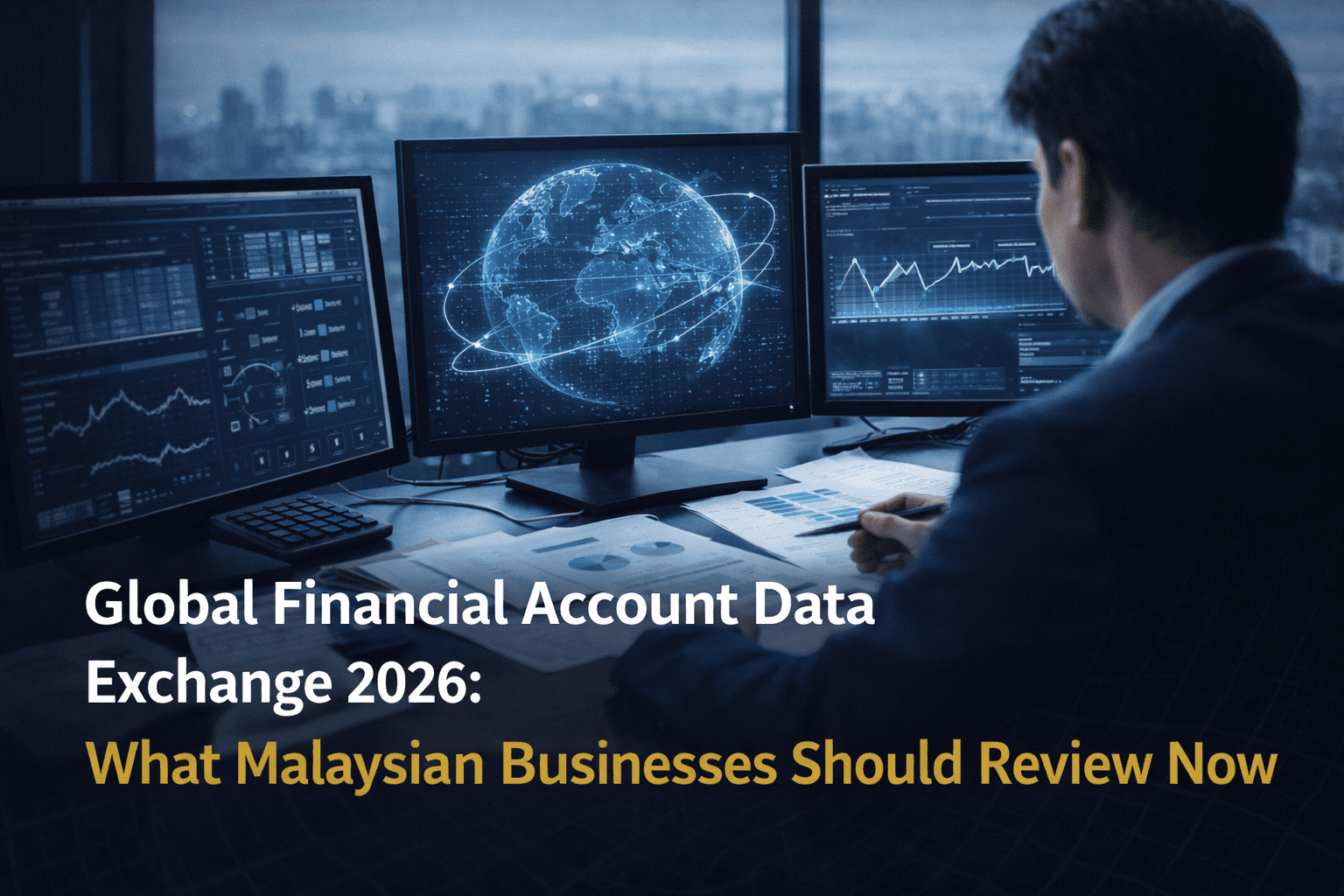
Malaysia has strengthened its participation in the automatic exchange of financial account information (AEOI) with foreign jurisdictions.
This development reinforces a global shift toward financial transparency.
For businesses operating across borders, this is not simply a regulatory update.
It represents increased visibility into cross-border financial activity.
The question is no longer whether information can be requested.
It is whether information is already being exchanged.
What Is the Automatic Exchange of Financial Account Information?
The Automatic Exchange of Financial Account Information (AEOI) is a global framework where participating countries share financial account data to improve tax compliance and transparency.
Under this system:
- Financial institutions collect relevant account information.
- Tax authorities exchange data across jurisdictions.
- Cross-border financial flows become more visible.
Malaysia’s participation signals alignment with international tax cooperation standards and reinforces expectations for accurate reporting.
Why This Matters to Malaysian Businesses
This development affects more companies than many directors realise.
It is particularly relevant for businesses with:
- Overseas bank accounts
- Foreign shareholders or directors
- Cross-border holding structures
- International subsidiaries
- Intercompany transactions
- Foreign-sourced income
If your company operates internationally, financial information may now be accessible across multiple jurisdictions automatically.
This increases the importance of consistent, well-documented reporting.
Increased Transparency Means Reduced Margin for Error
In a digitally connected tax environment, discrepancies become easier to detect.
Authorities can identify:
- Inconsistent reporting between countries
- Undeclared offshore income
- Mismatches in related-party transactions
- Incomplete disclosures
Many compliance risks arise not from intentional wrongdoing, but from structural complexity and outdated processes.
Disconnected reporting systems, incomplete documentation, or assumptions based on older enforcement practices can create exposure.
Common Risk Areas Businesses Should Review
Some areas that frequently require closer attention include:
Overseas Financial Accounts
Are all foreign accounts properly declared and reconciled?
Transfer Pricing Documentation
Are related-party transactions defensible and clearly supported?
Dividend and Intercompany Payments
Is the flow of funds properly recorded across jurisdictions?
Director and Shareholder Reporting
Are residency status and foreign income correctly aligned with filings?
Cross-Border Structuring
Does the legal structure match the financial reporting structure?
Transparency across borders means internal alignment is critical.
From Local Compliance to Global Alignment
Historically, many businesses approached compliance on a jurisdiction-by-jurisdiction basis.
Today, that approach is insufficient.
International reporting standards require alignment across:
- Financial records
- Corporate structure
- Tax filings
- Documentation
- Governance practices
A misalignment in one country may now be visible in another.
The focus must shift from isolated compliance to coordinated compliance.
What Businesses Should Do Now
Rather than waiting for queries or audits, proactive review provides control.
Practical steps include:
- Conducting a cross-border compliance review
- Reconciling overseas financial accounts with local reporting
- Reviewing transfer pricing documentation
- Ensuring consistency in related-party disclosures
- Strengthening documentation and governance frameworks
Clarity before scrutiny is always preferable.
Compliance as Stability, Not Burden
Global data exchange is not designed to create uncertainty.
It is designed to create transparency.
Businesses that maintain structured reporting systems operate with confidence, whether expanding, restructuring, or seeking investment.
Those relying on informal processes may face disruption at critical moments.
In today’s environment, strong compliance is not defensive — it is strategic.
How AMRE Management Services Supports Cross-Border Businesses
At AMRE, we support companies navigating cross-border compliance with clarity and precision.
Our focus includes:
- Cross-border tax alignment
- International reporting review
- Transfer pricing advisory
- Corporate structure assessment
- Governance strengthening
We prioritise structured, defensible systems that support long-term business stability.
Final Thought
The global exchange of financial account information marks a continued shift toward integrated transparency.
For Malaysian businesses with international exposure, the priority is simple:
Ensure your structure, reporting, and documentation are aligned across borders.
Reviewing now strengthens confidence later.
If your business operates internationally, this is the right time to assess whether your reporting framework is ready for a fully transparent environment.