
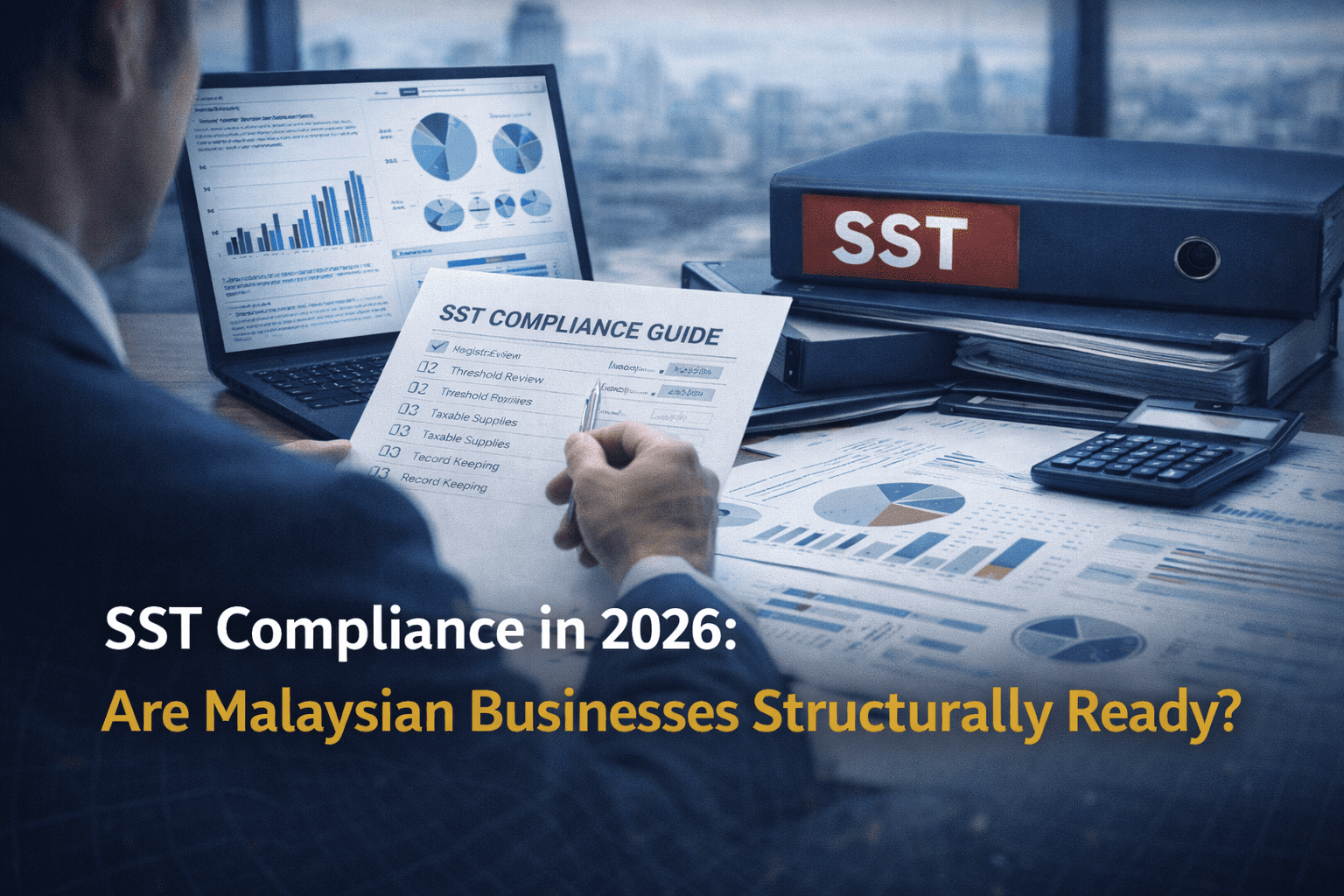
Sales and Service Tax (SST) remains a key part of Malaysia’s indirect tax framework.
While many businesses focus heavily on income tax, SST compliance gaps are often discovered during audits — not during daily operations.
In 2026, as digital reporting, enforcement monitoring, and cross-verification improve, the real question for businesses is:
Are your SST systems structurally aligned — or just operationally functional?
Why SST Still Creates Risk for SMEs
Unlike corporate tax, SST is transactional.
It affects:
- Every taxable sale
- Every invoice issued
- Every service rendered
- Every import subject to tax
Small structural gaps can multiply quickly.
Common issues often arise from:
- Incorrect classification of taxable supplies
- Missed registration thresholds
- Improper invoicing formats
- Incomplete record-keeping
- Misunderstanding exemptions
These are rarely intentional mistakes.
They are usually process weaknesses.
Registration Threshold: Are You Monitoring Growth?
Many businesses begin below the SST registration threshold.
But growth changes obligations.
If your annual taxable turnover exceeds the prescribed threshold, registration becomes mandatory.
The risk arises when:
- Revenue crosses the threshold gradually
- Different revenue streams are not aggregated properly
- Directors assume exemption still applies
Failure to register on time can result in:
- Backdated tax liability
- Penalties
- Cashflow strain
Growth should trigger compliance review.
Service Tax Expansion: Are You Affected?
Service tax scope has evolved over time, and certain service categories are frequently misunderstood.
Businesses in areas such as:
- Professional services
- Consultancy
- IT and digital services
- Management services
Must carefully review whether their services fall within taxable categories.
Incorrect assumptions create exposure.
The Hidden Risk: Invoicing & Documentation
SST compliance is not just about paying tax.
It is about documentation integrity.
Proper SST invoices must:
- Contain required information
- Reflect correct tax rates
- Show accurate taxable value
- Be retained for statutory periods
Disorganised documentation weakens audit defence.
In today’s digital environment, record consistency matters more than ever.
Cashflow Impact of Poor SST Structuring
SST errors do not only create penalties.
They affect cashflow.
Examples include:
- Undercharging SST and absorbing cost later
- Overcharging customers and facing refund disputes
- Miscalculating input adjustments
- Poor forecasting of SST payable
Indirect tax should be predictable — not reactive.
Structural Readiness vs Reactive Compliance
Many SMEs manage SST operationally:
They file returns.
They pay what is calculated.
They move on.
Structural readiness is different.
It means:
- Clear classification of supplies
- Automated calculation accuracy
- Regular revenue threshold monitoring
- Proper documentation procedures
- Internal review controls
Reactive compliance waits for audit.
Structural compliance prevents exposure.
Questions Directors Should Ask in 2026
- Are we correctly classified under SST law?
- Have we crossed any thresholds without realising?
- Is our invoicing system aligned with SST requirements?
- Are exemptions properly documented?
- Can we defend our calculations during audit?
If the answers are uncertain, review is necessary.
How AMRE Supports SST Compliance Structuring
At AMRE Management Services, we approach SST as a systems issue — not just a filing requirement.
Our support includes:
- SST registration assessment
- Taxable supply classification review
- Revenue threshold analysis
- Invoicing and documentation review
- Compliance risk assessment
Our goal is to ensure businesses operate with clarity and confidence — not uncertainty.
Final Thought
SST compliance in 2026 is no longer about basic filing.
It is about structural readiness.
As businesses grow, systems must evolve.
If your company has expanded, diversified services, or improved revenue significantly, now is the right time to review your SST position.
Compliance is not a burden.
It is protection for sustainable growth.