

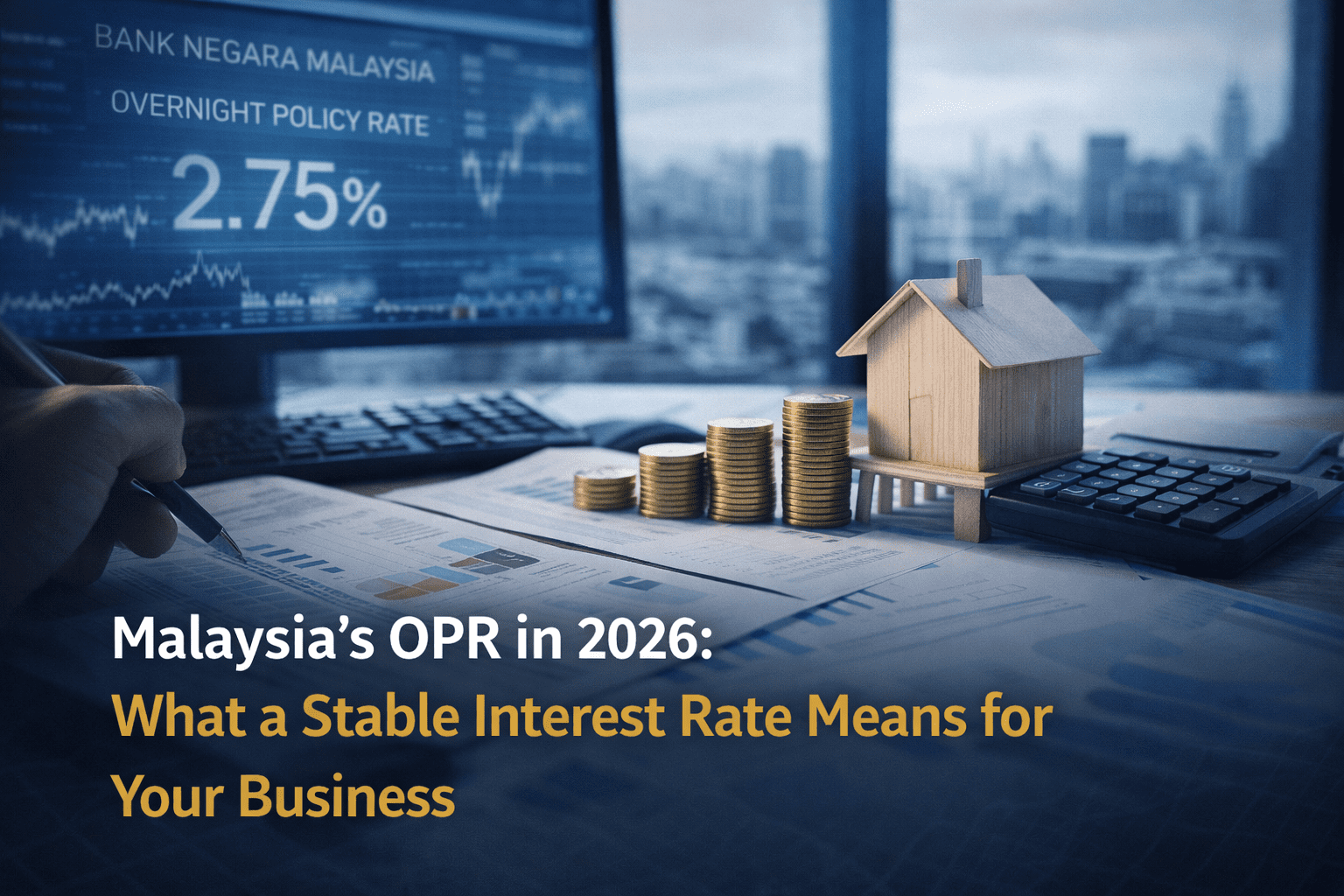
Bank Negara Malaysia (BNM) has maintained the Overnight Policy Rate (OPR) at 2.75%.
While this may seem like a macroeconomic update, it directly affects how businesses borrow, invest, and manage cashflow.
For Malaysian SMEs and growing companies, understanding what a stable OPR means can support smarter financial planning in 2026.
What Is the Overnight Policy Rate (OPR)?
The OPR is the benchmark interest rate set by Bank Negara Malaysia.
It influences:
- Commercial lending rates
- Business loan pricing
- Hire purchase and financing costs
- Corporate borrowing conditions
- Overall liquidity in the banking system
When the OPR moves, borrowing costs across the economy typically follow.
When it remains stable, it signals monetary policy confidence and economic balance.
What Does a Stable OPR Signal?
A stable OPR suggests that Bank Negara Malaysia views current economic conditions as manageable in terms of:
- Inflation
- Growth outlook
- Financial stability
- Credit conditions
For businesses, this creates a more predictable financing environment.
Predictability supports planning.
How This Impacts Malaysian Businesses
1. Business Loan Costs Remain Relatively Predictable
If your company relies on:
- Working capital facilities
- Term loans
- Property financing
- Expansion loans
A stable OPR reduces uncertainty around sudden increases in repayment costs.
This helps protect margins and cashflow forecasting.
2. Expansion Planning Becomes More Structured
When interest rates are volatile, businesses tend to delay investment decisions.
A stable rate environment allows companies to:
- Assess financing options confidently
- Negotiate loan terms strategically
- Structure capital expenditure with clearer projections
For companies considering growth, stability reduces hesitation.
3. Cashflow Management Improves
Stable borrowing costs allow better:
- Cost projections
- Budget forecasting
- Debt servicing planning
Unexpected rate hikes can disrupt financial planning. Stability allows businesses to focus on operational performance rather than reactive adjustments.
Should Businesses Still Be Cautious?
Yes.
Even with a stable OPR:
- Individual banks may adjust lending margins
- Credit approval criteria may tighten
- Market risks can still influence financing conditions
Businesses should avoid assuming stability equals low risk.
Instead, use this period to review financing structures and optimise cost efficiency.
Strategic Questions Directors Should Ask
- Are our current loan structures still competitive?
- Can we refinance at better terms?
- Is our debt-to-equity ratio aligned with growth plans?
- Are we overly exposed to floating-rate facilities?
- Do we have sufficient liquidity buffers?
Interest rate stability provides an opportunity for review, not complacency.
Turning Stability into Strategic Advantage
Strong businesses do not only react to rate hikes.
They use stable periods to:
- Restructure debt
- Strengthen balance sheets
- Improve credit standing
- Negotiate better banking terms
- Prepare for future volatility
Financial discipline during stable periods builds resilience during uncertain ones.
How AMRE Supports Business Financial Structuring
At AMRE Management Services, we assist businesses in aligning financial structure with long-term strategy.
Our support includes:
- Financial health reviews
- Cashflow and debt structure assessment
- Risk exposure evaluation
- Corporate structuring advisory
- Governance strengthening
We focus on building financial clarity and resilience — not just short-term adjustments.
Final Thought
The Overnight Policy Rate may appear technical, but its impact is practical.
A stable OPR in 2026 provides Malaysian businesses with a window of predictability.
The real advantage lies not in the rate itself —
but in how strategically your business responds to it.
If your company is planning expansion, refinancing, or reviewing its financial structure, now is the right time to assess your position.